
DLP — Digital Light Processing Television
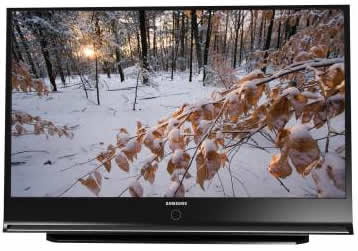
DLP (Digital Light Processing Television) is a technology that uses one, or sometimes three, electronic chips called Digital Micromirror Devices, or DMDs, to produce a vivid picture with a high contrast ratio on a high-definition large-screen TV. More than a million micromirrors mounted on the chip — five micromirrors, laid side by side, would fit across a human hair — respond to electric signals to focus the light from a white lamp either on, or away from, the TV screen. A one-chip DMD can produce more than 16 million colors when the light of each micromirror passes through a color wheel; a three-chip DMD produces several trillion colors.
DLP was developed by Texas Instruments in the late 1980s, and at one time was used in thousands of theaters around the world. At home, DLP could strut its stuff best on large screens — from 43” to around 84”— which made it ideal for home theaters.
DLPTs are frequently referred to as “projection” TVs, with rear-screen and front-screen projection models available. A 1080p DLPT has a resolution of 1,920x1,080 pixels, and an aspect ratio of 16:9. A 65” screen can be viewed easily from a distance of 5 yards.
DLPTs had several advantages over big-screen plasma and LCD TVs of the time:
- They were more economical, inch per inch.
- They were more svelte, being 13” to 15” slim and of a significantly lighter weight.
- They were more reliable, simply because they had fewer parts vulnerable to failure. Lamp bulbs did need to be changed every 15 years or so.
- They were immune to burn-in, which was caused by excessive gaming or by an ever-present logo in the corner of the screen.
Like its brethren the PC and the digital camera, each successive generation of DLPTs brought about an improved viewing experience by eliminating common causes for complaints. For example, speeding up the color wheel banished the annoying “rainbows” on the screen, and the too-narrow viewing angle — 30 or 40 degrees, similar to that of a PC screen — was expanded to up to 180 degrees. That said, however, the Society of Motion Picture and Television Engineers did still recommend that viewers be within 30 degrees of the picture “cone” for optimal viewing.
DLP televisions were eventually discontinued in 2012.